One could say that the days before a cross-country trip are usually filled with a multitude of tasks and anticipation of the good times to come. I’ll give a “yes” to both accounts and now we are back from coastal Alabama with pictures to share.
Paddling the Stellar S16S felt good in Perdido Bay off Alabama/Florida watersSteve and I congratulated Elizabeth and her husband Daniel as she earned her wings to become an Army Blackhawk helicopter pilot
Our happy travelling companion ElleElizabeth piloted a helicopter ride for each of us after graduation. Awesome!
I did a lot better travelling this past week than our last trip in November of 2015, that is for sure. I was able to attend all but one planned activity by pacing myself, meticulous planning, and some improvement in my overall health. The convulsive episodes that still accompany the serious illness I am battling kept themselves largely to the overnight hours and travelling in my truck. And they were much less! Yeah God! It’s amazing how much life can fit in between the setbacks these days . . .
Now that 11 loads of laundry are done, the travel trailer and vehicles are cleaned, and even some garden chores completed I am ready. A nasty new treatment begins later this week. Resuming the infusions of IV antibiotics, a few scheduled appointments, grocery shopping, and making sure our support systems are in place come first before the darkness falls. It really could be that bad. Or maybe not?
They say that breaking up stealth biofilm and killing protomyxzoa rheumatica (formerly known as FL1953) can render a person useless. Or bedridden. Or really, really sick. Then after around 4 weeks, there can be miraculous improvement. My trial run 2 weeks ago of 1 capsule of the anti-fungal brought dizziness, light-headedness, and cognitive slowing. My Lyme Literate Medical Doctor was thrilled when I told him. (He is kind of kooky that way!) “It’s affecting your brain! That is good!” he exclaimed in a way that only a master diagnostician can. Oh boy. “I wonder what the full dosing will be like?” was all I could think about. And how will I eat? Get to the bathroom? Keep up with all of the treatments while home alone when Steve is at work? So many questions remain unanswered at this point.
This is what I know for sure. In a way, the break in treatment for a week of vacation came too soon. I was not ready to go without the IV antibiotics and daily routine that has facilitated this turnaround without some extra struggle. There was a lot of stress amidst the good times. In another way, the break fed my soul! I got to see what living was like for everyone else while being with everyone else. I got to kayak with my beloved River Bear . . . . TWICE! I did more than one thing each day and did alright trying to do so. When we got back home I got to work in our garden two days in a row. Wow, Lord. Then I read an adventure novel in 2 days! How lovely it was to immerse myself in a bit of life again.
So for the unknown treatment coming in a few days I will say this: bring it. I have faced worse than lumbrokinase and prescription Lamisil. I will go slow if I can and employ every herxheimer (aka die off) remedy I have in my arsenal if needed. The Lord has brought me through near-death experiences, daily hell on earth, despair beyond belief. I have been given a taste of life again to encourage me and those around me as well. It is time to dig a little deeper, literally. We have found The Beast in the recesses of my brain tissue. This is war. Lord willing, I am going to get well.
If we don’t chat for awhile, please pray for me and Steve, k? Thanks a bunch Gentle Reader. I am grateful for you. With love, JJ
Enjoy the sweetness and reality of warmer weather throughout the United States and beyond from fellow blogger and friend, Sherri! Looky here for more on this subject. JJ
Each spring brings a new awareness to life. As my body adjusts to the weather and becomes more alive without pain, I enjoy hearing the birds sing as they do their morning chores. Of course, I sit with a cup of tea these days on the chaise lounge brought home from our cottage and listen…
Here’s a little ditty on Lyme disease that I wrote and was published in the Spring 2016 issue of Canoe News (for the United States Canoe Association). As it goes to print I just wondered if it may help someone out there? Take care Gentle Reader, JJ
Lurking in the tall grass
by Julie Horney
Somewhere out there by the side of the river, next to your boat–mobile or behind the garden shed may be a menace that could change your life forever. You may see it before it gets to you and you may not. It may be no bigger than the period at the end of this sentence! Perhaps you have been bitten many times before and think you are immune to its wrath. Maybe. Maybe not. One day that could all change so take heed: this message applies to EVERYONE!
Lyme disease is the fastest growing infectious disease in the U.S. Lyme has been reported in all 50 states although it is most prevalent in the Northeast, Northwest, and Great Lakes areas. The Centers for Disease Control and Prevention reported that there were 300,000 new cases in 2012 and estimates based on clinical diagnosis suggest there are over 1 million new cases yearly.*
Lyme disease (LD) is called a “vector–borne” disease transmitted by the bite of black–legged deer tick imbedded with the Borrelia burgdorferi (Bb) spirochete. LD is often complicated by Co–infections: other bacteria, protozoa, and viruses carried by the same ticks. Lyme is difficult to diagnose because fewer than half of all patients recall a tick bite or develop the signature erythema migrans (bull’s–eye) rash; the routine Lyme ELISA screening test has up to 60% false negativity. Similarly, testing for co–infections is also plagued by a high rate of false negativity. For example, research by the International Lyme and Associated Disease Society (ILADS) finds that joint swelling typically occurs in only 20% to 30% of patients. Given the prevalent use of over the counter anti–inflammatory medications such as Ibuprofen, joint inflammation is often masked. Based on these statistics, a significant number people who contract Lyme disease are misdiagnosed during the early stages leading to a chronic form of the disease which can prove even more difficult to diagnose and treat.
Lyme disease is often referred to as the “great imitator” because it mimics other conditions, often causing patients to suffer a complicated maze of doctors in search of appropriate treatment. While it may not be fatal, the consequences of Lyme and Co–infections can profoundly affect the quality of your life. In the words of my own Lyme Literate Medical Doctor (LLMD):
If you don’t treat it then your life will be hell.
Alright so now that I have your attention, let’s dig into the details. Isn’t there a difference between an acute infection and a chronic infection? The answer is yes. And since only an estimated 50% of ticks carry infection, how do I know that I have been affected if I do not have any symptoms? Lyme disease is difficult to diagnose without a rash, Bell’s palsy, arthritis, or meningitis but you can still have Lyme and not have any of those signs or symptoms! Many people react differently to the infection and experience fatigue, headaches, irritability, anxiety, crying, sleep disturbance, poor memory and concentration, chest pain, palpitations, lightheadedness, joint pain, numbness and tingling. The key is in the careful medical evaluation of ANY suspicious insect bite since they are all capable of spreading disease. (The CDC has stated that mosquitos can carry Lyme disease.)
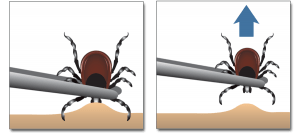
The diagram below shows the proper procedure for removal of an attached tick.
Removal of a tick from the CDC website****
Using fine pointed tweezers, grasp it from the side where it meets the skin, and gently pull it out in the opposite direction from which it embedded. My husband, Steve, and I each carry a pair of tweezers in our vehicles in addition to a First Aid kit for this purpose.
While the longer the tick is attached, the higher the risk of transmission, it is possible to get Lyme disease even if the tick is attached for less than 24 hours. The salivary juices of the tick, which contain anticoagulants, anesthetics, and immune suppressors, also contain microbes that can be injected at the time of attachment. (The anesthetic is why you don’t usually feel it biting you!) Transmission of bacteria by ticks attached less than 24 hours has been well documented in animals and a study published last year documented that this can occur in humans as well.*
Taking a “wait and see” approach to deciding whether to treat the disease has risks. If you do experience symptoms, you may even need to have more than one doctor evaluate them. Onset of Lyme disease symptoms can be easily overlooked or mistaken for other illnesses. Once symptoms are more evident the disease may have already entered the central nervous system and could be hard to cure. This is one case in which an ounce of prevention really is worth a pound of cure. Work with LLMD to identify the appropriate treatment option if you have symptoms and if those symptoms persist. There is more than one type of antibiotic available, often beginning with 20 days of Doxycycline or Amoxicillin. Longer treatment is also an option per guidelines at http://www.ILADS.org
Prevention
Strategies for the prevention of tick bites are do–able even for the avid paddler who finds himself standing in endemic areas on a regular basis! First and foremost avoid known infested areas and keep to trails, boat launches, and areas cleared of brush/grass/bushes. Next, invest in clothing treated with permethrin or treat clothing 24 to 48 hours ahead of time with permethrin (which is waterproof through several washings) including paddling shoes. Tucking light–colored leggings or pants inside socks or fitted ankle–high water shoes can be helpful; tucking shirts inside pants is also recommended. There should be no gaps in clothing such that skin is exposed.
An insecticide containing DEET is the standard repellent to use. The Centers for Disease Control maintains that repellents with the active ingredient of picaridin or oil of lemon eucalyptus are as effective as DEET for mosquitos but make NO CLAIMS for their effectiveness against ticks. Similarly, the EPA registers several essential oils and other natural remedies for safety but not effectiveness! Limited alternatives are available by searching their site.** Assist children in the safe application of all insect repellents and skin checks too. And do remember to protect your pets: dog and cat fur can act like a “tick magnet” carrying ticks inside your home. Consult with your veterinarian about tick–protection for your pets throughout the year.
When outdoors, periodically inspect your clothing and skin for ticks. Wearing light–colored clothing will make tick identification easier. Brush off those that aren’t attached and remove any that are with the method noted earlier. Some keep an adhesive–style lint roller handy to pick up loose ticks on clothing or pets. Once you are home, take a shower right away. This will wash away unattached ticks and offer a good chance to thoroughly inspect your skin. Feel for bumps that might be embedded ticks. Pay careful attention to hidden places including groin, armpits, back of knees, belly button, and scalp. This may seem strange but a quick skin check when sitting on the potty can be done anywhere, right?
Why bother? A Quick Story
Perhaps it was the tick Steve removed on me about 6 years ago or maybe it was the zillion mosquito bites I’ve had over the years that caused my four years of hell with Chronic Lyme Disease? We are not sure. At first we thought that when I got really sick it was the consequence of a biotoxin illness (exposures to blue green algae–infested water when kayaking then mold at home). For four years I sought medical advice from traditional, functional medicine, and alternative health practitioners; we spent tens of thousands of dollars out of pocket to no avail. We found secondary issues to resolve that often go along with what becomes a “chronic illness” such as mercury toxicity, Candida, parasites, dental issues, food sensitivities, hormonal issues, and more. Several doctors gave me a psychiatric diagnosis; others attributed it to “fibromyalgia.” Oy vey!
Convulsive episodes every day for 2 to 5 hours has created a living hell for both of us. Sometimes the seizure attacks are triggered by environmental toxins or fragrances and other times it’s the simple act of going to bed or waking up in the morning. The thrashing has created secondary orthopedic injuries that require their own treatment. Relief is generally temporary until the next round of torture coming within hours. I had become largely homebound with a litany of noxious symptoms and until recently, bedbound for most of the day, a minimum of four days per week. Extreme dietary measures including a ketogenic diet did nothing. Family visits still require extreme avoidance procedures.
Less and less was I able to cheer my beloved River Bear by the shores of the waterways here in Indiana . . . “gooooo Steeeeve.” I thought that my paddling days, ability to work, and ability to function normally at all were largely over. Welcome to late stage, neuro Lyme . . .
Tis funny how nothing is wasted for those who believe in the Lord’s sovereignty over one’s life. Initially I did have 5 weeks of antibiotics for a “clinical diagnosis” of LD even though virtually all of the fancy lab tests were negative. That first round of treatment in 2012 nearly killed me. I decided it wasn’t for me. But after treating all of those other conditions over the subsequent 5 years I would eventually become ready for intensive treatment of chronic Lyme disease with high doses of IV antibiotics.
At the time of this writing I am about 3 months into treatment. Placement of a power port by cutting into my chest wall was needed when the treatments got complicated. Neat huh? And at last there’s good news: the big turn–around has begun! Praise the Lord I am getting well!
Fellow paddlers, please take the prevention and treatment of Lyme disease seriously! Chances are good that someday this will touch the life of someone you know. Let not my experience be wasted! Share this information with your friends and family. Take precautions then let’s get on down the river, the beach, the intercostal waterway to enjoy the sport we love.
Perhaps soon you’ll see me as the one in a Stellar SR Multisport. :JJ
*Source: International Lyme and Associated Disease Society at http://www.ILADS.org







 Jesus is for the Wounded
You must be logged in to post a comment.